

Time to Read: 5m 14s
An assembler needs six different fasteners to build one subassembly. Instead of receiving those six components together, they walk to six bins, identify six part numbers, pull the required quantities, and bring everything back to the workstation.
Do that once, and the time may seem insignificant. Do it 40 times a shift, and the minutes add up quickly.
Fastener kitting doesn’t make the fasteners cheaper, but changes where the work happens. For a plant manager, the question is whether the labor, material handling, and error reduction justify the cost of having someone build the kit.
What Goes Into a Fastener Kit?
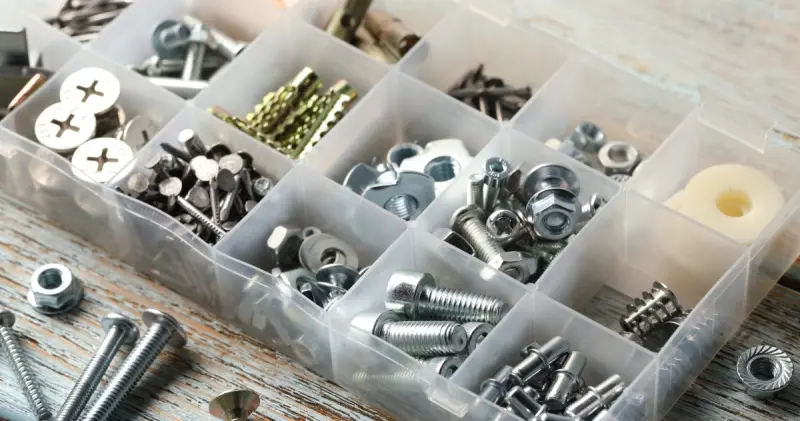
A fastener kit should be built around the actual assembly requirement, typically based on the bill of materials (BOM) or work instructions. For example, a kit might contain:
- 4 × 1/4-20 × 1-inch pan head machine screws
- 4 × flat washers
- 4 × lock washers
- 4 × hex nuts
- 2 × specialty fasteners
- Required clips, pins, or other hardware
The exact contents depend on the application. Kits can be fastener-only kits, hardware kits, mixed component kits, or subassembly kits. The kit should also be clearly identified by part number, assembly, revision, and quantity. The objective is to give the assembler exactly what is required for a defined production task.
How Fastener Kitting Works Against a BOM
A typical kitting process starts with the manufacturer’s BOM. The supplier identifies the required kit configuration, pulls each component from inventory, verifies the part number, size, material, finish, and quantity, then assembles and packages the components in a bag, box, tray, or other appropriate container. The completed kit is labeled with the information production needs and delivered to the warehouse, production area, or line.
BOM revisions are especially important. If an assembly changes from four 1-inch screws to six 1.25-inch screws, the kit configuration needs to change with it. Kitting services should account for those revisions rather than continuing to build an outdated configuration.
What Does a Kit Actually Save?
In our earlier six-bin example, without kitting, the assembler has to read the work instructions, walk to the first bin, identify and count the part, then repeat the process at five more locations. If something is missing or the wrong component was pulled, the assembler leaves the line again.
Kitting moves much of that work out of the assembly process. The potential savings include:
- Walking and searching: Less travel between the workstation and inventory.
- Counting: Required quantities are already pulled.
- Part identification: The kit identifies the components needed.
- Material staging: Components arrive together.
- Line-side inventory: Fewer individual bins may need to be maintained.
- Error prevention: The opportunity to pull the wrong part or quantity can be reduced.
Consider an assembler who spends three minutes collecting six fastener types and does that 40 times per shift. That’s two hours spent gathering hardware rather than assembling the product.
Kitting Can Save More Than Assembly Labor
The savings don’t stop at the assembly station. Kitting can also reduce work associated with line-side replenishment, material staging, inventory organization, shortages discovered during assembly, and separating hardware for recurring jobs.
For procurement, instead of purchasing six different SKUs through multiple orders or suppliers, they can place one PO for the completed kit.
Perhaps the biggest benefit is consistency. Instead of every assembler independently gathering six components, the same assembly receives the same standardized material package.
When Does Fastener Kitting Stop Being Worth It?
Kitting may not make sense when an assembly uses only a few components, fasteners are already located at the point of use, demand is highly unpredictable, or the kit changes frequently because of engineering revisions.
Someone still has to pick, count, verify, package, and deliver every kit. If that work costs more than the repetitive labor it removes from the production line, kitting doesn’t make economic sense.
Rule of thumb: When the repetitive work removed from the assembly line is worth more than the labor and materials required to build the kit, opt for kitting.
How to Determine Whether Your Line Is a Good Candidate
Start with one recurring assembly and ask:
- How many fastener part numbers does it require?
- How many times is it produced per shift?
- How far do assemblers travel to collect the parts?
- How often are incorrect quantities or components pulled?
- How much time does material staging consume?
Rather than estimating from memory, time the process across 20 to 50 assemblies. Then calculate the minutes spent gathering, multiply that by assemblies per shift, and factor in labor cost, material handling, and errors. That gives you a better basis for comparing the current process with the expected cost of kitting.
What to Look For in Kitting Services
A supplier providing kitting services should be able to work from your BOM, maintain part number accuracy, handle revisions, count and verify components, package and label kits consistently, manage inventory, and deliver according to production requirements. The supplier should understand that the kit is in effect a production input.
How Blue Ribbon Fastener Can Help
Blue Ribbon Fastener combines fastener sourcing with kitting coordination, giving manufacturers the option to place one PO for the completed kit. We work from customer BOMs, specifications, and required quantities and build kits around the actual production application. For small jobs and expedites, BRF can kit in-house. For larger jobs, we work with third-party kitting partners to match the approach to job size, volume, and urgency.
This gives manufacturers a single point of accountability. If a component is delayed, specifications change or an order needs to be expedited, there’s one supplier to contact.
We built our approach around the same things manufacturers expect from BRF’s broader service: fast response, accurate sourcing, clear communication, and proactive notice when supply issues arise.
Count the Minutes Before You Count the Savings
Instead of focusing on eliminating six bins, think about whether an assembler should spend production time collecting components instead of building the product.
Choose one recurring assembly. Count the fastener part numbers. Time the picking and staging process. Multiply those minutes across your production volume. If the cost is meaningful, fastener kitting may be a straightforward way to move repetitive work away from the production line.
Blue Ribbon Fastener can help manufacturers evaluate recurring assemblies and determine where kitting makes operational and economic sense. Get in touch with us today for a super fast quote.