

Time to Read: 6m 42s
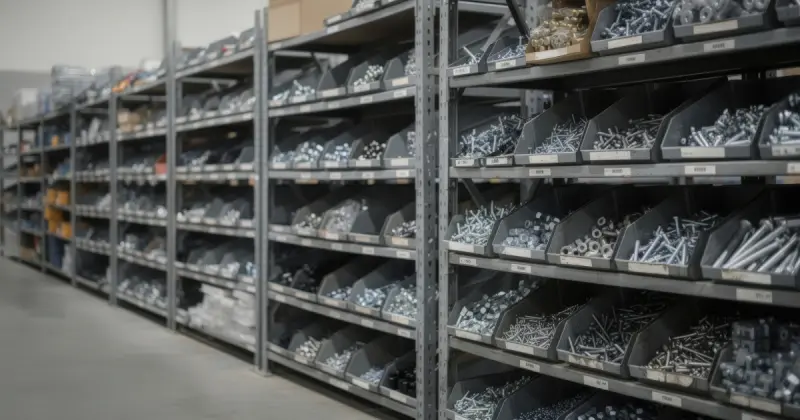
Fasteners can represent a relatively small percentage of an OEM’s overall spend while consuming a disproportionate amount of procurement and production management time. A fastener wall may contain dozens or hundreds of SKUs, each with different specifications, usage rates, packaging requirements, and replenishment cycles.
Traditional vendor-managed inventory (VMI) removes much of that burden by putting supplier personnel on-site to monitor and replenish inventory. A virtual managed inventory program takes a different approach. The customer handles the physical movement of fasteners while a scan automatically triggers replenishment. The central questions for procurement are: Where does the plant want the labor to sit, and how much is that labor worth?
Traditional VMI vs. Virtual VMI: What’s the Difference?
Traditional VMI puts the supplier in charge of replenishment. A supplier employee enters the customer’s facility, checks the fastener wall, and fills bins as needed. The customer receives a managed replenishment service with limited internal labor. The customer also avoids breaking down incoming cartons and putting fasteners into bins.
The supplier absorbs employee time, travel, vehicle expenses, fuel, and other overhead associated with on-site replenishment. Those costs become part of the economics of the program and affect the unit cost of a fastener.
A virtual vendor-managed inventory program moves the physical inventory work back to the customer while automating the ordering process. A production manager or associate scans empty or low bins using the supplier’s app on the associate’s handheld device equipped with an inexpensive Bluetooth scanner. The scan triggers the replenishment order, the supplier processes and ships the order, and the customer receives the shipment and puts it away.
The Pros and Cons of Traditional VMI and Virtual VMI
A traditional vendor-managed inventory program offers a high level of managed service. The supplier handles bin replenishment and monitors the physical hardware wall. That arrangement works best when fastener purchasing represents a small part of the overall procurement workload but requires significant physical management.
Traditional VMI makes sense when a fastener wall contains a large number of SKUs. A long tail of low-volume parts creates substantial inventory management work even when individual items have low usage.
The trade-off is the cost of that service. Supplier personnel need time to travel to the facility and perform the work. A missed visit can create an inventory problem requiring immediate attention, especially when a fastener shortage could interrupt production.
Virtual VMI reduces the recurring supplier overhead associated with on-site replenishment. The customer uses its workers and relatively inexpensive scanning equipment, while the supplier handles order processing, picking, and shipment.
That makes virtual VMI particularly sensitive to SKU count. A manageable fastener wall may require limited labor, while a large wall with a long tail of low-volume SKUs makes physical inventory management much more demanding. The comparison is fundamentally about labor, service level, and cost.
How Does Virtual VMI Work?
The customer and supplier identify the covered SKUs and confirm part numbers, dimensions, grades, finishes, packaging, and other specifications. The parties establish bin quantities, expected demand, and commercial terms.
Each bin receives an identifiable part code. A two-bin system can make the process more efficient. When one bin becomes empty, the second bin moves into place, and the empty is scanned for replenishment.
In virtual VMI, the supplier doesn’t need to continuously monitor inventory or receive detailed production reporting for every replenishment cycle.
What Does Virtual VMI Cost Compared With Traditional VMI?
Traditional VMI economics include the fastener unit price plus the cost of the supplier’s on-site service. Employee labor, travel, vehicles, fuel, and related overhead all contribute to the economics of physical replenishment.
In virtual VMI, the customer absorbs the labor for scanning and put-away, while the supplier avoids recurring travel and on-site replenishment costs.
The labor inputs for the customs are a production employee scanning bins on a periodic basis, as well as put-away when replenishment arrives. Equipment costs are low, using BYOD (phone or tablet) and the inexpensive Bluetooth scanner.
Virtual VMI is not less expensive by default. The cost is dependent on SKU count, internal labor costs, and the amount of physical inventory management required. A plant with a manageable hardware wall may find the labor minimal, while one with a large, complex SKU mix may place greater value on supplier-managed replenishment.
How Much Data and Labor Does Each Model Require?
Traditional virtual-managed inventory requires the supplier to understand the covered SKUs, specifications, inventory locations, expected usage, and replenishment expectations. The supplier also needs access to the hardware wall.
Virtual VMI calls for accurate part identification, correct bin assignments, and a functioning scanning process, as well as customer labor for scanning, receiving, and put-away. The customer does not need to provide the same level of demand visibility because the scan directly signals what’s needed for replenishment.
In sum, traditional VMI transfers more inventory management labor to the supplier, while virtual VMI transfers the physical inventory work to the customer while automating ordering.
Which Plants Are a Good Fit for Virtual VMI?
A virtual vendor-managed inventory program can work well when a plant has a manageable number of fastener SKUs, recurring demand, and an organized hardware wall. The plant also needs a production manager or associate who can dedicate limited time to scanning and put-away.
Traditional VMI may make more sense when the fastener wall contains a very large number of SKUs or when the long tail of low-volume parts creates substantial physical inventory management work.
As SKU count increases, customer labor requirements increase with it. At some point, diminishing returns kicks in. Paying for supplier-managed replenishment may make more economic sense than assigning additional production labor to the hardware wall.
When Does a Stocking Agreement Make More Sense?
A stocking agreement addresses a different procurement need. A customer may want assured access to an agreed inventory position while retaining control over how fasteners move into and out of the facility. Purchasing may prefer to manage replenishment rather than production personnel. A supplier may hold dedicated inventory for the customer under agreed commercial terms.
Stocking arrangements can also make sense when a shortage could interrupt production, demand changes quickly, or fasteners require specific kitting, labeling, or point-of-use delivery.
What Should Procurement Ask Before Choosing a VMI Model?
Before choosing what type of vendor-managed inventory program, procurement should ask:
- How many fastener SKUs are included?
- Who will physically replenish the bins?
- How much employee time will replenishment require?
- Who owns the inventory?
- Who triggers replenishment?
- How quickly can the supplier ship after a scan?
- Who handles put-away?
- What happens when specifications or approved parts change?
- How will annual forecasts affect pricing and inventory planning?
- What happens when demand exceeds expectations?
The answers reveal whether the plant needs supplier labor, automated ordering, or a stronger inventory commitment.
BRF’s Approach to Virtual VMI and Stocking
Blue Ribbon Fastener supplies parts to OEMs in aerospace, lighting, contract manufacturing, and data center infrastructure. BRF supports customers evaluating traditional VMI, virtual VMI, and stocking arrangements based on the customer’s SKU mix, usage patterns, and inventory requirements. All our VMI programs cover fasteners, hardware, and other Class C components. They help OEMs maintain reliable access to in-demand parts while reducing the time and labor required to manage recurring replenishment.
BRF’s virtual VMI gives customers a streamlined ordering process while retaining responsibility for physical inventory handling. We bring sourcing capability, product availability, and responsive communication to recurring fastener programs. Our goal is to match the inventory program to your actual operation rather than adding service costs that your plant does not need.
Match the VMI Model to the Labor You Want to Manage
The right model depends on SKU count, internal labor availability, demand patterns, and the value of supplier-managed service. For an operation evaluating a virtual managed inventory program without adding headcount, the first question is simple: How much time can the plant realistically devote to managing the fastener wall?
Contact Blue Ribbon Fastener to discuss which model works best for your operation. Get a super fast quote here