

Time to Read: 6m 13s
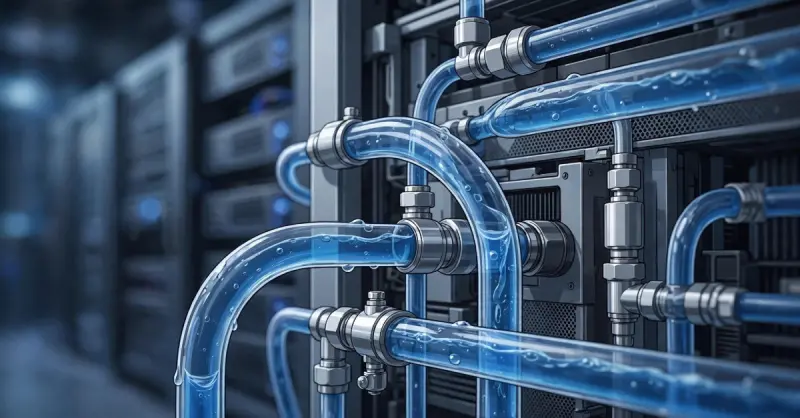
The need to deal with the tremendous amount of heat generated by AI data centers is a growing problem. Liquid cooling is emerging as the best solution for dissipating the heat, but it raises its own set of concerns over how to retrofit existing facilities now using below-floor air cooling. The potential for downtime as well as the cost and complexity involved make retrofitting a difficult and costly proposition.
Liquid Cooling Quickly Replacing Air Cooling in Data Centers
At its Global Summit in San Jose, California, the Open Compute Project made the pronouncement that air cooling of data centers is fast being replaced by liquid cooling as the standard for dealing with massive thermal buildup.
According to the International Energy Agency’s Key Questions on Energy and AI report, data center electricity demand was up 17% in 2025, compared to just 3% growth in global power demand. Data center electricity use is projected to double by 2030, with AI-specific demand growing by 3x. AI-focused data centers saw their electricity use grow 50% last year.
Power — and thus heat concentration and cooling requirements in data centers — is advancing rapidly. While NVIDIA’s MGX 1.2 specification supports racks of up to 250 kW, OCP sees “a clear path to 1 MW racks.” All this means data center operators need to make infrastructure decisions now to support the next generation of chips and their power and cooling requirements.
Our take: For plant operators and data center developers, the move to liquid cooling means hardware requirements must be built into project forecasts early. Changing rack designs can affect demand for fasteners, fittings, and attachment hardware. BRF helps manufacturers source standard and application-specific components as specifications and production needs evolve.
The Complexity of Liquid Cooling Retrofits
While liquid cooling for data centers is clearly the wave of the future, retrofitting a facility built for air cooling is a much more difficult undertaking than a new build designed for that purpose, experts say.
According to Data Center Knowledge, challenges include space constraints for piping in an existing facility, where server rooms are already filled with networking gear and cabling. Racks must be repositioned, cable pathways reworked, and new routes created for distributing coolant to the racks. Other physical changes may be required as well, such as reinforcing raised floors that weren’t designed to support the greater weight of racks, especially in AI environments.
The potential for downtime from structural changes that can take months, as well as disruption from the cooling system changeover, are issues that must be addressed.
Our take: Liquid cooling retrofits create a different sourcing challenge than new construction. Existing floor structures, rack layouts, and piping routes may require additional support hardware or revised attachment solutions. Plant operators and developers should involve suppliers early, confirm specifications against site conditions, and allow time to source application-specific components before retrofit work begins.
Issues at the Rack: High-Density AI Creating Difficulties in Power Conversion
The standard practice of running high-voltage AC power to server racks and then converting it to DC power is running into a dilemma when it comes to high-density AI environments. The amount of power loss in the conversion process has moved beyond a rounding error, according to reporting in Power.
High-voltage AC may be efficient when it comes to transmission, Power notes. But that benefit goes away with power loss during DC conversion at the rack, which also generates more heat that must be dealt with.
Delivering DC to the rack is one option, but this would require bypassing servers’ power supplies built for AC, violating the manufacturer’s warranty terms. As well, the entire distribution network would have to be custom built from the substation to the rack.
Our take: Reengineering rack-level power delivery can change the Class C parts list as manufacturers adopt new connection methods and distribution layouts. Revised designs may require different thread and fitting standards, new mounting patterns, or additional fasteners per rack. Purchasing teams should review BOMs with engineering early and confirm specifications and quantities before sourcing begins.
Honeywell Tests Aerospace Cooling Module for AI Data Centers
Equinix, the largest data center colocation and interconnection provider in the world, has tested and installed Honeywell Aerospace’s Thermal Response Module at its Co-Innovation Facility in Ashburn, Virginia, according to Data Center News. This marks Honeywell’s first entry into AI data center thermal management with technology adapted from aerospace and defense applications.
Designed for liquid-cooled AI infrastructure, the module helps stabilize coolant temperatures during power disturbances, sudden changes in computing demand, or disruptions elsewhere in the cooling system. Installed between the coolant distribution unit and servers, it uses phase-change materials to store and release thermal energy, providing a buffer while the broader system responds. Honeywell says the unit can help protect GPU performance and prevent damage associated with cooling fluctuations.
The installation comes as rising processor power and rack density increase demand for reliable liquid cooling. According to research from Omdia, liquid cooling is deployed in fewer than half of data centers, but the market is expected to grow 20% annually over the next five years. Honeywell says its module can integrate into existing cooling loops without system redesign or being tied to a specific coolant distribution unit supplier.
Our take: As thermal buffering becomes another component in liquid-cooled data center designs, manufacturers should account for its mounting and connection requirements in the Class C parts list. New modules can introduce different fitting standards, mounting patterns, and fastener quantities per rack, making early BOM reviews essential to sourcing.
Envision Claims First 800V DC Power System for AI Data Centers
China’s Envision Energy says its Dubhe platform is the first 800-volt DC power system operating in an AI data center, according to Gadget Review. Installed at the company’s Galaxy AI campus in Inner Mongolia, the system converts 10 kV grid-level AC directly to 800-volt DC for AI racks using solid-state transformers.
By eliminating intermediate AC-to-DC conversion stages, Envision says the architecture reduces energy losses and heat while supporting denser rack deployments. Integrated battery storage absorbs rapid power fluctuations from GPU workloads and provides backup during interruptions.
The company also claims higher-voltage distribution can reduce current and copper cabling requirements. However, the reported efficiency gains, equipment reductions, and copper savings have not been independently verified. The campus is operating with live computing workloads, but its planned 3 GW capacity and one million accelerators remain future targets. Wider deployment will depend on reliability testing, standardized protection practices, and independent validation.
Our take: The move to 800V DC power distribution could reshape the Class C parts lists for data center power equipment and rack assemblies. New transformer and battery designs may require different mounting patterns, fastener specifications, and hardware quantities. Manufacturers should review BOMs early and confirm sourcing as designs move toward production.
The AI Data Center Juggernaut Rolls On, But Power and Cooling Issues Persist
Data center growth is driving rapid changes in cooling and power infrastructure, from liquid-cooled racks and retrofit projects to new thermal management systems and 800V DC distribution. Each development can introduce new fastener specifications, mounting requirements, fittings, and hardware quantities that affect production and installation schedules.
Blue Ribbon Fastener helps data center equipment manufacturers source standard and application-specific fasteners, liquid cooling fittings, and related attachment hardware for evolving designs. With responsive quoting, custom samples to blueprint, and PPAP as a Service, BRF supports purchasing teams as requirements develop. Contact us today to discuss your data center hardware sourcing needs and get a super-fast quote.